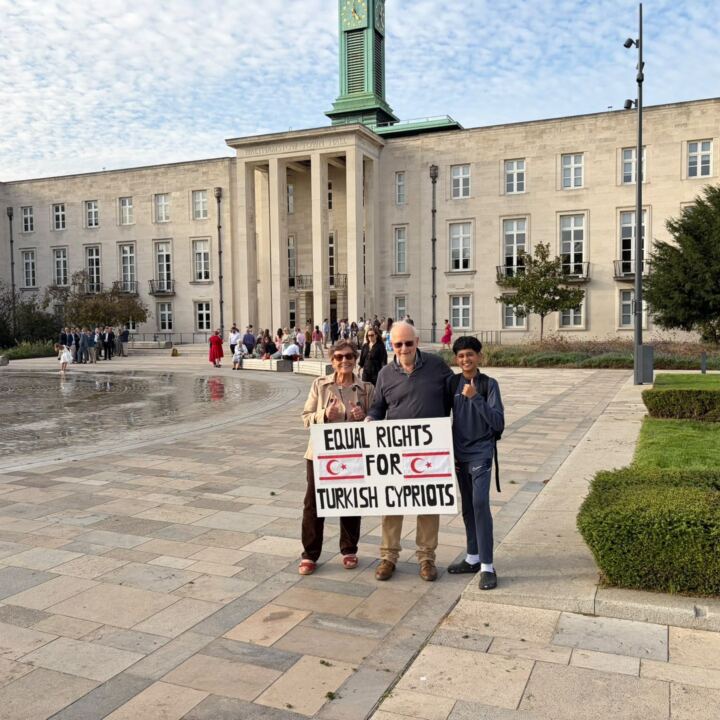
Join us on Saturday, 21st December 2024, as we come together for the “Remember Bloody Christmas by Candlelight” event. This event seeks to honour the victims of the 1963 Bloody Christmas Massacre, a tragic moment in Cypriot history that marked the violent targeting of Turkish Cypriots. To understand the depth of this event, we share a detailed account of the massacre and its devastating impact on the Turkish Cypriot community, as described below.
The following article sheds light on the events that led to the massacre, the atrocities committed—including the heartbreaking story of the İlhan family—and the far-reaching consequences that continue to affect Turkish Cypriots to this day. To understand the events of ‘Bloody Christmas’, which took place in Cyprus in 1963, we first need to understand the context in which they occurred.
The Road to Conflict: The Power-Sharing Agreement and Its Collapse
With the withdrawal of Great Britain as the colonial power, 1960 saw the birth of the newly independent Republic of Cyprus. It was a new partnership state, formed as the result of a delicate power sharing agreement between the Greek Cypriot and Turkish Cypriot communities. The agreements were backed by their respective motherlands, Greece and Türkiye, and by Great Britain, who would retain two sovereign British bases on the south coast of the island. The three countries undertook to guarantee ‘the state of affairs’ created on the island, in the hope that Cyprus would prosper in the hands of Greeks and Turks and serve as a catalyst for peace and friendship between Greece and Türkiye and in the region as a whole. It was such a finely balanced agreement that the then US President, Dwight D. Eisenhower, declared that “The conclusion of an agreement on Cyprus is recognized throughout the world as a victory of common sense. I think that it is much more than that; it is also an imaginative and courageous act of statesmanship which cannot fail to strengthen and encourage the whole NATO alliance.”
Unfortunately, despite being a signatory to this historic agreement, the view held by the leader of the Greek Cypriot church leader and the first President of the fledgling Republic, Archbishop Makarios, was less than enthusiastic or celebratory. His aim throughout the talks was, and evidently remained, the achievement of Enosisi (the union of Cyprus with Greece). He did not seek or accept independence, but instead wished the island to become an integral part of Greece. And he made no attempt to hide those views, despite the obvious concern they would cause among the signatories of the agreement and, most importantly, among the Turkish Cypriot community. Just three weeks prior to the celebration of formal independence (which took place on 16th August 1960), he proclaimed that “the agreements do not form the goal – they are the present and not the future. The Greek Cypriot people will continue with their national cause (Enosis. The union of Cyprus with Greece) and shape their future in accordance with their will.”
It was not the first such statement from him, and in case anyone doubted his objective or would have us believe that he softened his approach in the months and years following independence, he made a speech in the village of Panaya on 4th September 1962 in which he chillingly warned that “Until this Turkish community forming part of the Turkish race which has been the terrible enemy of Hellenism is expelled, the duty of the heroes of EOKA can never be considered as terminated.“. Those heroes of EOKAii of whom Makarios spoke of were the Greek Cypriot terrorist organisation who, just like Makarios, had not fought for independence, but for nothing less that Greek rule of Cyprus.
Makarios’ Vision for Enosis and the 13-Point Plan
It should therefore come as no surprise that Makarios remained deeply unhappy with the idea of power sharing agreement and sought to frustrate it at every turn. From independence through to early 1963 he had blocked the formation of separate Greek Cypriot and Turkish Cypriot municipalities – a mandatory provision of the partnership republic, which intended to allow each community limited control over low-level community affairs. After he ignored the protests of the Turkish Cypriot ministers in February of that year the matter was escalated to the new Republic’s Supreme Constitutional Court. The court included one Greek Cypriot judge, one Turkish Cypriot judge and an Independent Neutral President, the German national, Prof. Forsthoff. The Archbishop immediately declared that, if he were ruled against, he would simply ignore it. The Supreme Constitutional Court ruled in favor of the Turkish Cypriots, but Archbishop Makarios, unmoved, simply ignored the decision, leading the Neutral Supreme Court President to resign in protest. Embarrassed by the Archbishop’s brazenness, Greece sought to distance themselves from his actions, declaring that “It is not permissible for Greece in any circumstances to accept the creation of a precedent by which one of the contracting parties can unilaterally abrogate or ignore provisions that are irksome to it in international acts which this same party has undertaken to respect.”
Undeterred, the Archbishop ploughed on with his attempt to seize control of the state apparatus. He aimed at downgrading the status of the Turkish Cypriots from their constitutionally agreed status as equal sovereign partners to reduce them to a simple minority in a Greek state. To this end, he now presented a plan consisting of ‘thirteen points’, which he insisted required amendment because they had created “many difficulties in the smooth functioning of the state and the development and progress of the country”, although he included no evidence to support the claim. In reality, the thirteen amendments which he put forth were a crude attempt to strip the Turkish Cypriots of all protections provided to them within the Cyprus constitution. A move which, if accepted, would leave them at the total mercy of a community who had made it abundantly clear that their objective was not for Cyprus to be an independent Cypriot state, but for the island to be united with Greece. The Turkish Cypriot community’s wishes were not even deemed worthy of consideration. The thirteen amendments involved the removal of no less than eight of the basic articles of the constitution and went as far as removing the critical right of veto, provided to the Turkish Cypriot Vice-President, Dr Fazil Kuçuk, precisely in order to prevent such a power-grab. The Turkish Cypriots, backed by Türkiye, refused to budge and steadfastly insisted on their equal rights. Having found himself incapable of seizing power by political means, the Archbishop now attempted to do so by force of arms.
The Spark: The Murder of Two Turkish Cypriots
On 21st December 1963, two Turkish Cypriots were shot dead in the capital, Nicosia by unofficial Greek Cypriot ‘Special Constables’. The Special Constables were a new force created by Makarios without consultation or agreement. The creation of such a force (made entirely of one community) were not provided for anywhere in the Cyprus constitution. In short, far from being there to keep the peace between the two communities, they were nothing more than civilian thugs in uniforms. The deaths of the two Turkish Cypriots signaled the start of the campaign of Greek Cypriot violence which came to be known as ‘Bloody Christmas’. Three days later, on Christmas Eve, the first of the organised military operations took place as co-ordinated attacks against Turkish Cypriots were carried right out across the island.
On 28th December the Daily Express carried the following account of one such attack “We went today into the sealed off Turkish Cypriot Quarter of Nicosia in which 200 to 300 people have been slaughtered in the last 5 days. We were the first Western reporters there and we have seen sights too frightful to be described in print. Horror so extreme that the people seem stunned beyond tears”.
The Greek Cypriots argued that this was simply inter-communal strife and they reassured the world that the forces of law and order (ie Greek Cypriot forces) were now restoring calm. It was apparently an internal matter.
There was to be no restoration of calm and no law order. In early January 1964 it was discovered that, on the 26th December, almost the entire Turkish Cypriot inhabitants of Ayios Vassilious had been massacred on the outskirts of their village. The Red Cross assisted with the exhumation of their twisted remains and confirmed that many of the dead had been buried alive. They included men, women, elderly and children.
The Tragedy of the İlhan Family: The Bathtub Murders
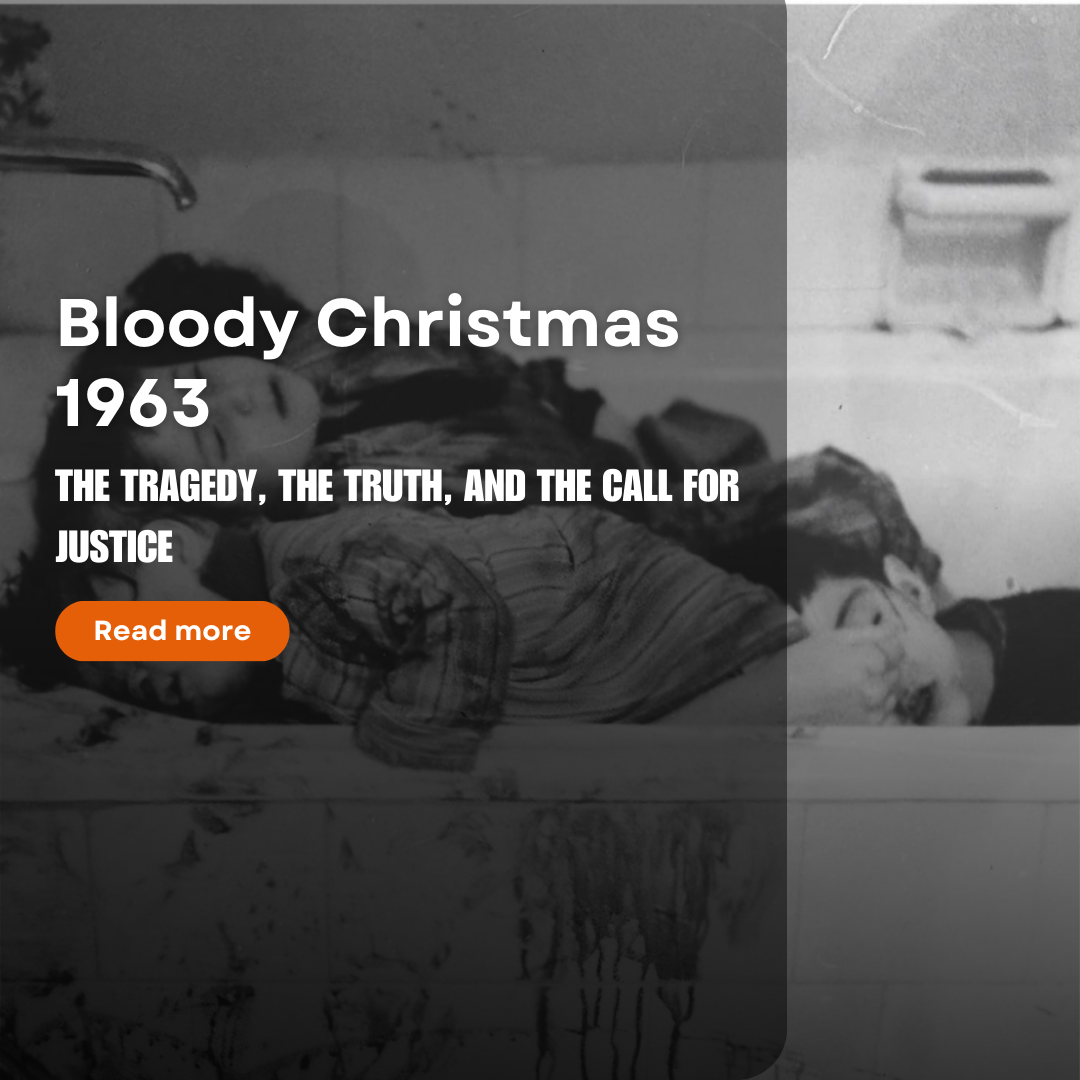
While it would be wrong to point to any one event as any more shocking or brutal than another, perhaps the most infamous and heart-wrenching symbol of ‘Bloody Christmas’ is what came be known as ‘the bathtub murders’.
Major Dr Nihat Ilhan had formed part of a mainland Turkish force consisting of six hundred and thirty men, who were stationed on the island as part of the Guarantor Agreement. The same agreement also allowed for nine hundred and fifty mainland Greek forces in a separate base. On the evening of the 21st December, just as the first of the Greek Cypriot attacks broke out, Dr Ilhan was on duty at the hospital. It was during his shift that a group of armed Greek Cypriots, many of whom were in military uniform, stormed his home in the Turkish Quarter of Nicosia. In a desperate attempt to hide herself and her children, his wife, Mürüvet, hid in the bath with her three sons, Murat (6 years), Kutsi (5 years) and Hakan (10 months). They were discovered and were brutally shot and killed. The gunmen also shot and killed the landlord’s wife, Feride Gudum, who was either present at the time or had perhaps inadvertently entered the house when she heard the commotion.
Attempts to Cover Up the Atrocities
The following day’s press photos, showing the tragic sight of a mother and her three children lifeless in the bloodstained bath, became a tragic symbol of the violent onslaught of Christmas 1963.
Greek Cypriots sought to cover up the atrocities, claiming them to be the result of intercommunal violence involving both communities, rather than a pre-planned attack by one heavily armed and organized side against another, who were helplessly outnumbered and outgunned. However, the press reports of the day and the disparate numbers of the dead tell their own story. As a result of the ‘Bloody Christmas’ attacks, 1% of the entire Turkish Cypriot population of the island were killed and a further 25% were displaced. 109 Turkish Cypriot villages were totally or partially destroyed as well as 107 mosques. The Guardian reported on 31st December 1963 that “It is nonsense to claim, as the Greek Cypriots do, that all casualties were caused by fighting between armed men of both sides. On Christmas Eve many Turkish Cypriot people were brutally attacked and murdered in their suburban homes, including the wife and children of a doctor – allegedly by a group of forty men, many in army boots and greatcoats.”
The campaign of violence continued into the new year, with the Italian press reporting in ‘Il Giorno’ on 14th January 1964 “Right now we are witnessing the exodus of Turkish Cypriots from the villages. Thousands of people abandoning homes, land, herds. Greek Cypriot terrorism is relentless. This time the rhetoric of the Hellenes and the statues of Plato do not cover up their barbaric and ferocious behaviour”. The scene of devastation was also reported by the UN Secretary General to the UN Security Council (UN doc.S/8286) confirming that “When the disturbances broke out in December 1963 and continued during the first part of 1964 thousands of Turkish-Cypriots fled their homes, taking with them only what they could drive or carry, and sought refuge in safer villages and areas.”
‘Bloody Christmas’ was therefore not only a bloody campaign of violence (or as some would argue, an attempt at genocide ), but it caused the physical separation of the two communities (eleven years before the events of July 1974) and directly led to the collapse of the power sharing government on the island. It therefore caused not only the deaths of a great many Turkish Cypriots, but also of the new Republic of Cyprus itself.
Note to our readers
The Bloody Christmas by Candlelight Remembrance Evening is not just an act of remembrance, but a call for justice, truth, and recognition of the struggles faced by the Turkish Cypriot community. We invite you to join us at:
📍 13 St James’s Square, London SW1Y 4LB
🕔 5 PM – 7 PM, Saturday, 21st December 2024
Together, let us pay our respects, honour the lives lost, and stand in solidarity for justice and peace.
Justice for Turkish Cypriots. We remember, we honour, and we demand recognition.